Island territories arrive at COP31 with a financing map, not a wish list
Six years of work by the EU-funded Green Overseas Programme close with five financing mechanisms that island territories can actually use. Representatives from the Caribbean, the Pacific, the Atlantic, the Indian Ocean and the Arctic are taking them to Antalya.
Island territories have never had trouble explaining what they need. Sea walls, water storage, grid upgrades, mangrove protection, food systems that do not depend on a monthly supply ship. The harder question has always been the one that comes next: who pays, and through which door.
This November, delegations from across five oceans arrive at COP31 in Antalya with a clearer answer than they have had before. Behind them sits a feasibility study commissioned from ODI Global, which worked through 18 financing mechanisms and narrowed the field to five with real potential for overseas countries and territories. Behind that sit six years of the Green Overseas Programme, funded by the European Union under its Global Gateway strategy and implemented by Expertise France, and 31 projects built territory by territory.
The programme presented its findings at a closing forum in Paris at the start of November. Antalya is where it hands them over.
Overseas territories are not parties to the Paris Agreement in their own right. They are covered through the European country or the United Kingdom they are constitutionally linked to, and some were not covered at all until very recently. Greenland came under the Agreement only in 2024, through the Kingdom of Denmark.
That constitutional status, rather than the scale of the need, is what keeps these territories on the margins of the climate finance system. The major multilateral funds were designed around sovereign states. Eligibility is then judged on the income per capita of the country a territory is attached to, which counts the territory as wealthy whatever its own circumstances.
The result is a mismatch that the Green Overseas press kit describes as a climate and finance paradox. These territories contribute very little to global greenhouse gas emissions. They absorb the full force of rising sea levels, coral reef degradation, cyclones, drought, flooding and coastal erosion. They hold a share of the planet’s biodiversity out of all proportion to their size. And they sit outside most of the funding built to respond to exactly those conditions.
Scale makes it harder again. A project that would be routine on a continent becomes difficult on an island, where the absolute sums are small, the transaction costs are the same as anywhere, and a single damaged port or water main can affect the whole territory at once.
Six years, 25 territories, five oceans
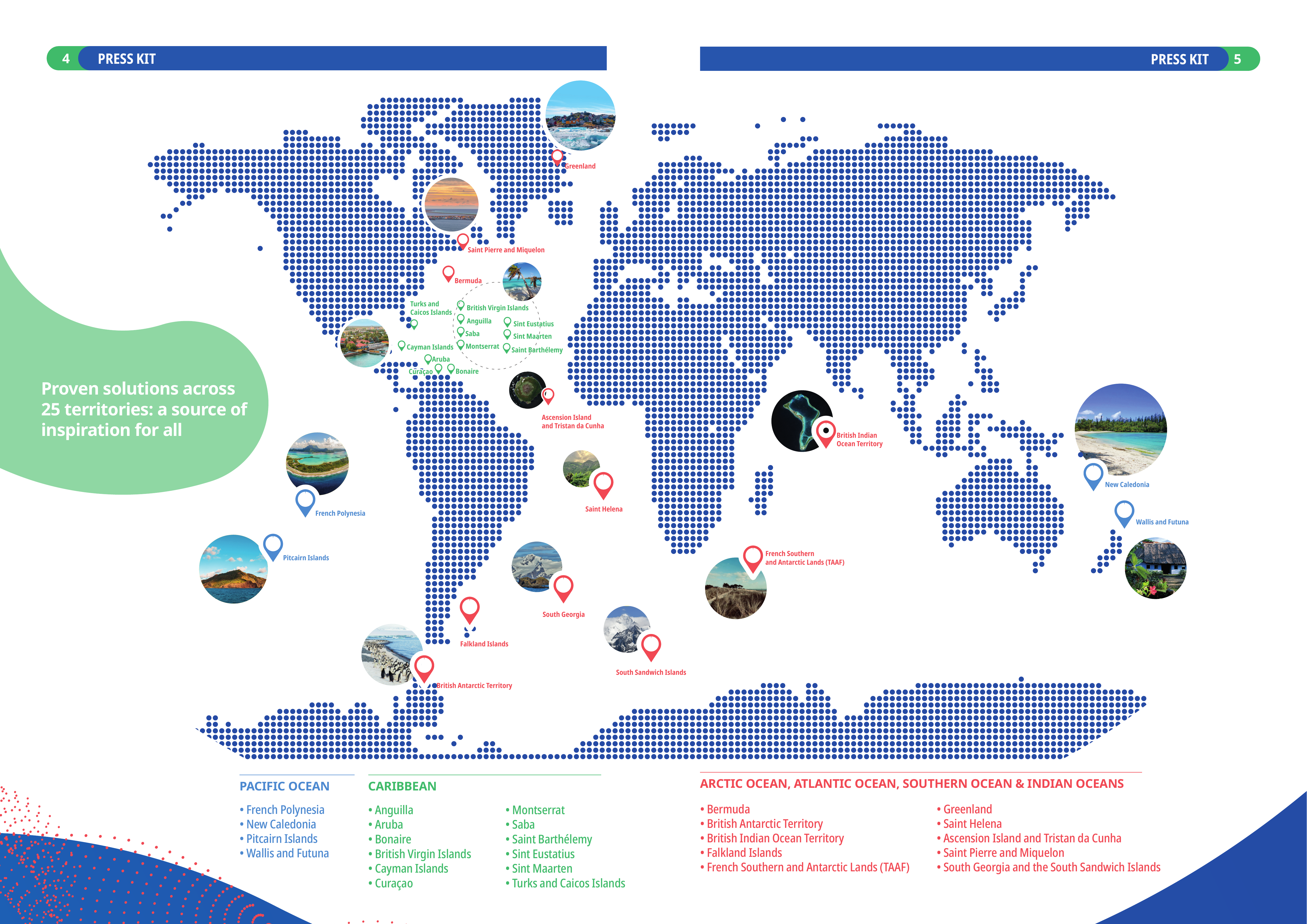
The Green Overseas Programme ran from 2020 to 2026 with €17.8 million of European Union funding. It worked with 13 overseas countries and territories associated with the EU and 12 overseas territories associated with the United Kingdom: 25 in all, spread across the Caribbean, the Pacific, the Atlantic, the Indian Ocean and the Arctic.
Together those territories cover 19 million km² of land and sea and are home to more than 1.2 million people. The land area is modest. The maritime area is not, and it is the reason the seagrass, mangrove, peatland and reef systems in these places matter well beyond their own shorelines.
Over six years the programme delivered 31 Green Overseas Facilities, six studies and policy briefs, three interactive climate finance tools and more than 20 workshops and training sessions. Of the 31 territory projects, 17 addressed climate resilience and nine the energy transition, covering water security, coastal mapping, local food production, building codes, government vehicle fleets and groundwater management.
Five mechanisms, and what they look like in practice
The ODI Global study mapped 18 mechanisms and selected five for detailed analysis. Its central finding is that no single mechanism suits every territory. What works depends on financial autonomy, private sector activity, data quality, the extent of the ecosystems involved, and the legal and governance capacity available locally.
Each of the five already has a working example somewhere across the territories or the wider Caribbean.
Green and blue bonds
These suit territories with developed financial systems, enough private sector activity and the capacity to service debt. In the Cayman Islands, Caribbean Utilities Company raised USD 50 million in 2024 for renewable energy, energy efficiency and climate adaptation projects.
Carbon markets
Island territories hold carbon stores that are substantial by any measure: roughly 4,500 km² of peatland in the Falkland Islands, 930 km² of seagrass meadows in New Caledonia and 800 km² in the Turks and Caicos Islands. Blue and terrestrial carbon finance can support conservation and coastal protection at the same time. The demands are real, though. Data, certification and proof of additionality all have to be in place first.
Conservation trust funds
A proven route to long-term revenue for marine protected areas and ecosystem restoration. On Ascension Island, a GBP 2 million endowment established the AIMPACT fund, which supports environmental activities from its investment returns. In Niue, companies and individuals can contribute NZD 250 to protect one square kilometre of ocean for 20 years.
Blended finance
Public, concessional, philanthropic and private capital combined to reduce risk and attract investors who would not come in alone. It covers everything from renewable energy and resilient infrastructure to small and medium-sized enterprises. In the Caribbean, EU-backed blended finance is supporting start-ups that develop commercial products from sargassum seaweed.
Environmental and sustainability levies
Tourist taxes, protected area entrance fees and tourism-related contributions generate regular local revenue, and they work best when the money is channelled into a dedicated fund. Aruba charges visitors a USD 20 contribution, which gives the island a predictable stream for climate infrastructure and conservation.
The barriers are rarely the instruments
The study is clear that the obstacle is not a shortage of financial instruments. The common barriers are technical and legal complexity, a shortage of investment-ready projects, and transaction costs that are hard to absorb when the investment itself is small.
Three responses have emerged. The first is to bundle small projects around a shared theme, such as seagrass meadows, mangroves, peatlands or coral reefs, and present them to funders jointly. Each project stays locally managed, while preparation, certification and fundraising costs are pooled. The second is to build dedicated project preparation and incubation capacity inside the territories, supporting feasibility studies, financial structuring and dialogue with investors. The third is a blended finance vehicle offering guarantees, first-loss capital, concessional loans and technical assistance.
“Improving access to finance was a common need expressed by all OCTs and OTs. In response, GO’s Climate Finance Community developed tools, provided training and conducted joint studies to raise awareness and strengthen stakeholders’ capacities,”— Robert-Jan Moons, Secretary of the GO Programme’s Expert Working Group on Climate Finance.
From local priority to investable project
A financing mechanism is only useful if there is something to finance. The 31 projects run through the programme were designed to close that gap: to help territories assess their priorities, identify practical interventions and put a cost against them. Four of them show the range.
Sint Maarten: the first national picture of climate risk
Sint Maarten completed its first national climate adaptation report in 2026, bringing together existing knowledge that had never been synthesised. Sea levels around the territory are projected to rise by 22 centimetres by 2050 and by up to 78 centimetres by 2100.
The report also puts a value on what is already there. The island’s remaining 22.7 hectares of mangroves and coastal ecosystems provide services worth more than USD 76 million a year. With around 80% of the economy dependent on tourism, protecting those systems is an economic decision as much as an environmental one.
The same territory ran a hydroponics training-of-trainers pilot. Across nine schools, 27 teachers and community members learned to build, operate and maintain hydroponic systems. The schools harvested 98 kg of vegetables and herbs, and pupils were introduced to a method of growing food that needs very little soil.
Ascension Island: 39 tonnes of demand, six tonnes of supply
Ascension Island produces around six tonnes of vegetables a year against an estimated demand of 39 tonnes. Everything else arrives by ship.
A Green Overseas study assessed four priority investments: expanded hydroponic production, a 300-hen laying unit, a small processing facility and bakery equipment. Together they were costed at approximately GBP 87,000 and could raise the island’s vegetable self-sufficiency to 65%. The options have been assessed and costed. They are not yet funded, and that is precisely the point at which a financing route is needed.
Falkland Islands: three ways to secure the water supply
Around 80% of the Falkland Islands’ population lives in Stanley, which depends on two rainfall-fed reservoirs. Water demand is projected to rise by 35 to 40% by 2050, while rainfall is expected to become less reliable.
Three options have been costed: groundwater development at approximately GBP 2.5 million, a new river intake at GBP 5.3 to 8.8 million, and desalination at GBP 6.8 to 8.4 million. The analysis will also determine abstraction and storage capacity and lay the groundwork for an early warning system to support decision-making in emergencies. The remaining task is to find a financing route for whichever option the territory selects. The Falklands are separately exploring blue and green finance mechanisms, including conservation of the peatland that makes the islands a significant carbon store.
French Polynesia: 84 interviews and eight public meetings
A study covering six Tuamotu atolls and Pointe Vénus in Tahiti projected shoreline change over a 30-year period, identifying the additional loss associated with climate change and storm impacts. Erosion on these coastlines is not uniform. It depends on geomorphology, currents, development, ecosystem health and how the land is used.
The method is as notable as the finding. Eight public meetings and 84 interviews brought local and traditional knowledge into the assessment, so the resulting coastal planning advice reflects how people actually use the shoreline.
A new pot of money for the UK territories
One announcement at the Paris forum went beyond the programme itself. The Foreign, Commonwealth and Development Office presented its new Climate Finance Support Programme, a three-year pilot worth £20.5 million and expected to mobilise in 2027.
The pilot is aimed at strengthening climate finance support for UK Overseas Territories. Its existence says something about where the argument has reached. The difficulty these territories face in accessing international climate finance is now recognised at departmental level, as is the need for support that turns a climate priority into something an investor can assess.
What happens in Antalya
Green Overseas and its partners will contribute to five sessions across the CARICOM, France and Benelux Pavilions. The themes are climate finance, energy cooperation, youth-led climate action, just transitions, and the use of climate data in island decision-making.
Three youth delegates travel with the programme, and two of them go as panellists rather than observers.
Riddhi Samtani, from Sint Maarten, speaks at the Benelux Pavilion on 13 November on turning climate data into island action. Ilona Mayerau-Lonné, from New Caledonia, speaks at the France Pavilion the same day on aligning climate, development, jobs and investment. Najannguaq Berthelsen joins from Greenland, the territory that came under the Paris Agreement only two years ago and used the programme to build the evidence base for its first climate strategy.
Institutional representatives from French Polynesia, the British Virgin Islands, Saint Helena, the Cayman Islands and the Azores are also expected to attend.
What six years leave behind
The programme closes, but the material it produced does not. Three interactive tools remain available: a marketplace tool for identifying solutions and private investment opportunities, a climate finance guidance tool, and a quick governance scan tool that lets ministries, public agencies and sectoral departments assess how well their own structures align with climate adaptation standards, regulatory frameworks and incentives.
There is also a body of evidence that did not exist in 2020. Costed options for water security in the Falklands. A national climate risk assessment for Sint Maarten. A resilience index for the Cayman Islands. A shoreline projection for French Polynesia built with the communities who live on those shorelines. A groundwater management plan for Anguilla. A decision-support tool for nature-based solutions in New Caledonia. An erosion management roadmap for Saint Pierre and Miquelon. A tide gauge on Pitcairn.
“A territory that has anticipated risks, adapted its infrastructure, organised its services and prepared its population will be able to significantly reduce the impacts of climate change,” said Lina Tode, GO Programme Regional Coordinator for the Caribbean.
Another workstream looked at the legal question underneath all of this: what it would mean to extend the Paris Agreement to overseas territories, which are not automatically included, and whether a Multidimensional Vulnerability Index could replace the per capita income measure that currently governs eligibility. That argument is not settled. It is the one worth watching after Antalya.