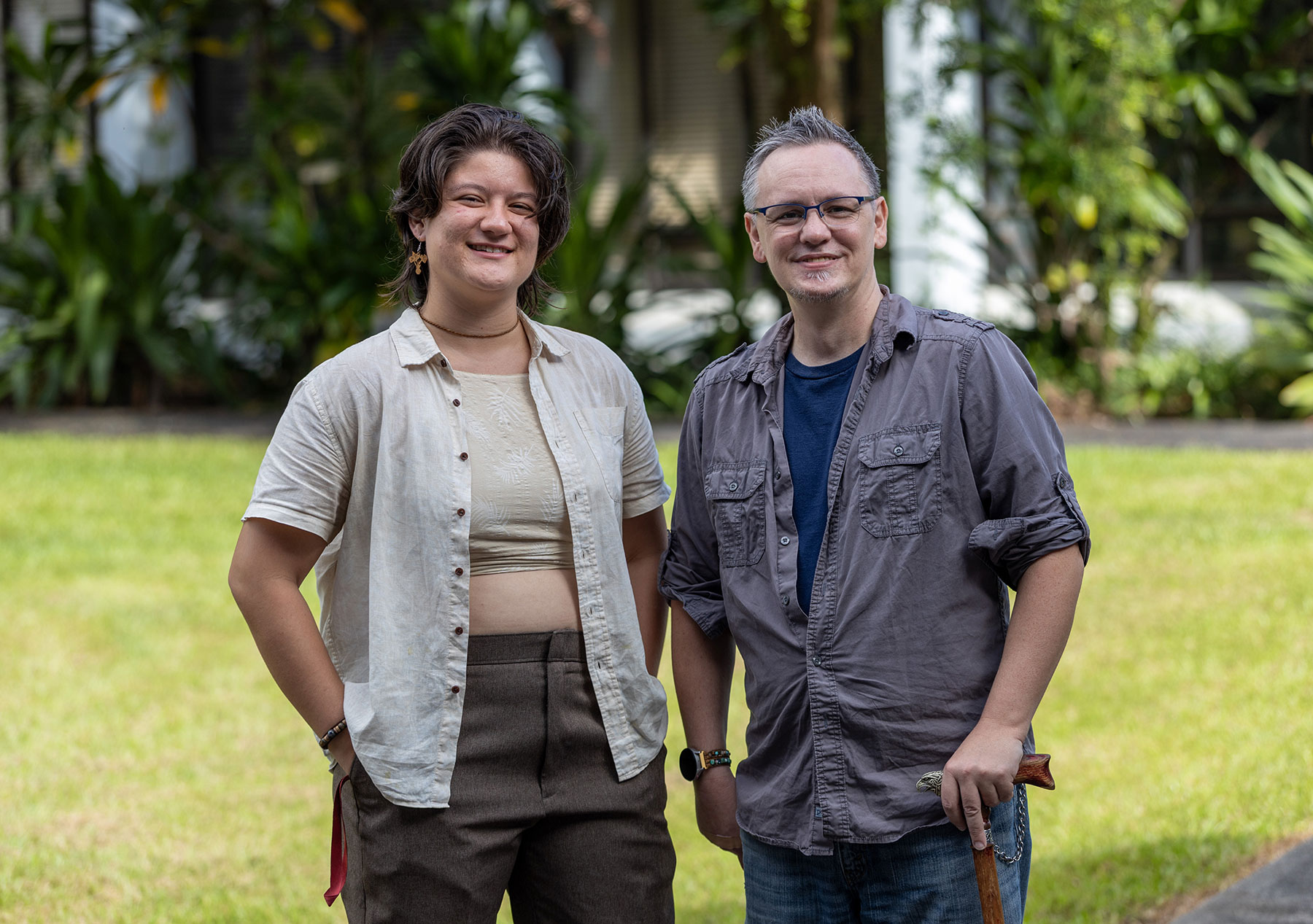
Two University of Hawaiʻi at Hilo seniors just beat out hundreds of global competitors — including corporate research teams — to win a $50,000 national NASA award by proving ancient Hawaiian farming holds the key to feeding astronauts on Mars.
Out of over 100 final competitors in NASA’s Deep Space Food Challenge: Mars to Table, ʻOhā Kanu — created by Leilani Jensen and Raven Kromer — was selected as one of only five winning designs nationwide. Their design adapts the ancient Hawaiian ahupuaʻa land management system into a modern, multi-zone space agricultural framework. By integrating hydroponics, aquaculture, field crops, and orchards, the zero-waste system creates a self-sustaining ecosystem that eliminates reliance on resupply from Earth.
“One of the jokes we made was, ‘Ancient Hawaiians were the first space explorers,’” said Kromer, an astronomy and English major who publishes research under the name Raven Daegmorgan.
Ancient Wisdom Meets Deep Space Technology
The project name, ʻOhā Kanu, references the young taro offshoot (ʻohā) and the act of planting (kanu). Unlike standard agricultural models that maximize short-term yield, ʻOhā Kanu focuses on long-term resilience and complete nutrient cycling.
“We drew upon traditional and indigenous perspectives for how to produce food,” explained Jensen, a tropical agroecology and environmental science double major. “It was not about designing for maximized productivity. It was designed so that there’s always food on the table, no matter what happens.”
The Four-Zone Closed-Loop Framework
The framework links four ecological zones where waste from one zone fuels the next. To maintain astronaut health and morale, the duo mapped over 200 crops, programmed custom USDA nutritional tools, and curated a varied two-week menu — which they personally cooked and taste-tested over the summer.
Overcoming Obstacles and Beating the Clock
The national win came despite a major hurdle: Kromer and Jensen discovered the contest in April — three months late. They could only begin full-time work in May after spring final exams. Balancing summer jobs and coursework, they spent nights building database tools and refining ecosystem layouts.
“We did get a bit of a late start,” Kromer said with a laugh. “But the nature of the challenge itself — supporting deep space exploration and contributing to NASA's public science programs, along with its applicability to food security on Earth, especially here in Hawaiʻi — was a strong motivator to keep working at it.”
Despite their success, both students admit the national win came as a shock.
“If my younger self could see me now, they would not believe it, because I’m a scientist and I got to compete in a NASA competition and actually won,” Jensen shared. “I’m still kind of in disbelief.”