
How Can Malta’s Experience Inform The ODA Graduation Conversation for Small Island Developing States?
For Small Island Developing States (SIDS), graduating from official development assistance (ODA) can mean losing access to vital affordable finance. Malta had a different path available – and its experience offers lessons for reforming how aid graduation works.
ODI Global’s Resilient and Sustainable Islands Initiative (RESI) just hosted its annual summer school at the University of Malta, as part of a leadership training course for professionals from small island states. Spirits were high as participants engaged with experts and debated solutions to the various economic, social and environmental challenges common to many Small Island Developing States (SIDS). However, many worry about the financial challenges ahead. SIDS already make up a significant share of the countries that have already graduated from eligibility for Official Development Assistance (ODA), and many have since struggled to access affordable finance for critical public investment. Meanwhile, over the next decade, 11 more SIDS will lose access to the development aid which is vitally important for their economies and for sustainable development.
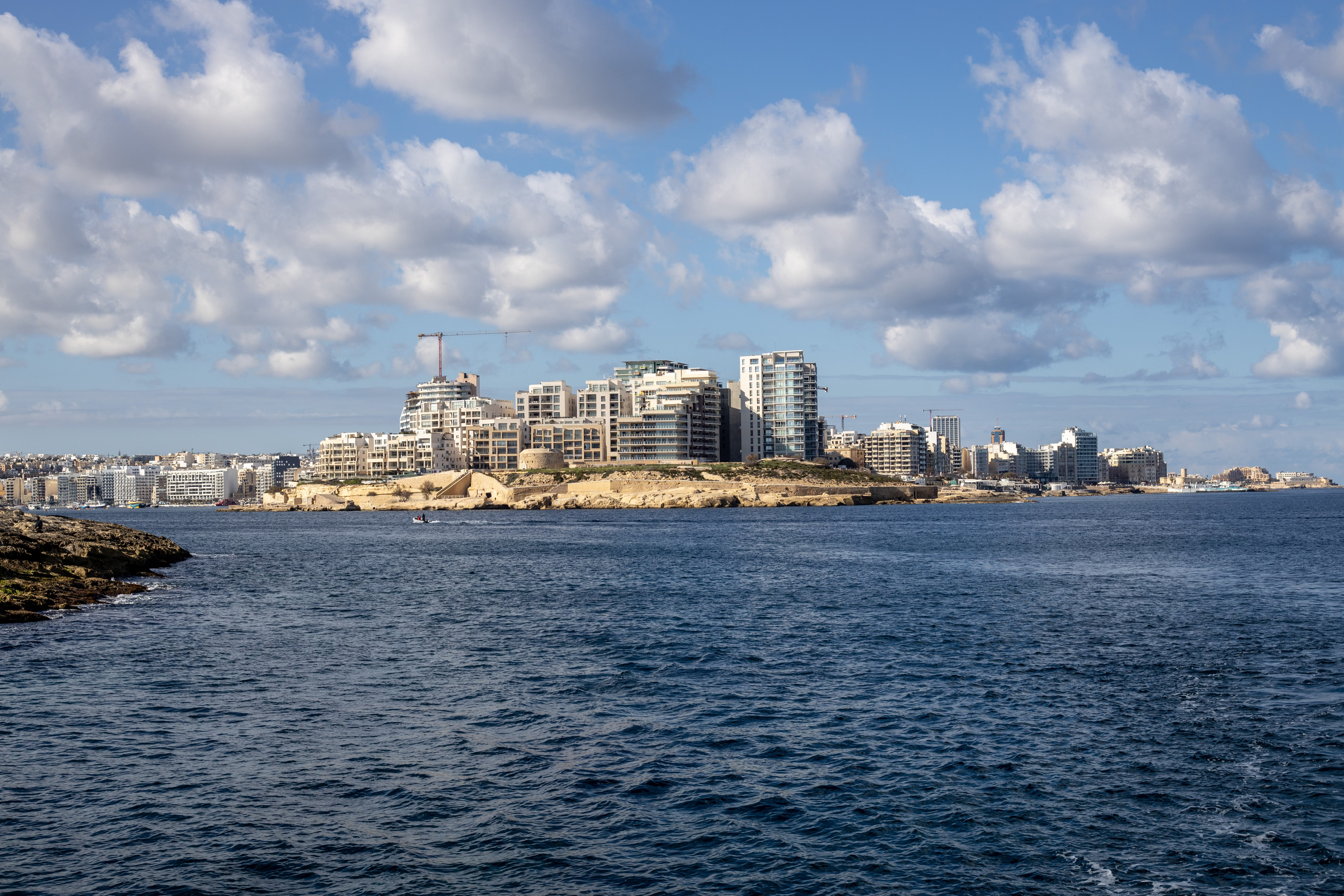
These experiences are very different to that of Malta, the host country, formerly a small island developing state and founding member of the Alliance of Small Island States (AOSIS). Malta graduated from aid eligibility over 20 years ago and today is an advanced, innovation-driven economy. Malta’s success provides some useful lessons for how the international community could re-think current approaches to international aid and development financing.
The challenge of ODA graduation for SIDS
Graduation poses particular challenges for small island nations. Research shows that aid flows to SIDS cannot easily be replaced by other financial flows. At the point of graduation, SIDS are much more reliant on aid than other developing countries about to graduate, with aid constituting 38% of external finance flows on average for SIDS, compared to just 2% for non-SIDS. SIDS are also highly vulnerable to frequent and severe climate-related shocks. SIDS make up two thirds of the nations that experience the highest relative annual losses from disasters. Research by RESI shows how this has contributed to debt sustainability challenges. Only two of the eleven potentially graduating SIDS have debt-to-GDP ratios lower than 60% (a widely used debt sustainability risk benchmark for developing countries) and two have debt in excess of 100% GDP. Access to affordable financing to support recovery is incredibly important, especially because SIDS have a high cost of capital when it comes to borrowing on capital markets. Of the six already ‘graduated’ SIDS, four have restructured their debt in some way over recent years: the Bahamas and Barbados were voluntary restructurings, the Seychelles and St. Kitts & Nevis were not.
RESI has looked at the fiscal costs borne by SIDS when replacing aid with market rate borrowing following graduation. In three that have already graduated – Antigua & Barbuda, the Seychelles and Trinidad & Tobago – the fiscal cost of graduation amounted to at least 4% of tax revenues: a considerable sum.
Malta’s experience is very different.
Malta’s alternative path
A year after graduating from ODA eligibility in 2003, Malta became an EU member state, gaining access to EU Structural and Investment Funds (ESIF). Pre-accession, Malta also had access to some EU funding, but this was incredibly small compared to the massive financial flows that were unlocked once it became an EU Member State. Essentially, while one aid window closed, another, much bigger, opened.
Between 2014 and 2020, Malta received about €828mn in EU funds and its current 2021-2027 allocation stands at around €796m. Malta has been able to build public infrastructure, including transport and water, and improve environmental and resource efficiency, including renewable energy, as well as business competitiveness and human capital through education, skills and training. Because Malta is so small, this funding has had a disproportionate impact on physical infrastructure. For example, between 2014-2020, ESIF investment represented about 30% of Malta’s entire public investment. Of course, Malta has also contributed co-financing to many projects and its contributions to the EU budget must be deducted from the amounts cited above. However overall, since its accession to the EU, Malta has remained an important net beneficiary of key EU money. While loans from the European Investment Bank (EIB) have also been important for Malta, most of Malta’s EU funding has been in the form of grants, not loans.
What does this experience teach us when it comes to other small island nations?
Three lessons from Malta’s experience stand out.
First, it challenges the overriding assumption underpinning the current aid paradigm: that higher-income countries have a lower need for aid than countries at a lower income level. Malta’s public investment programme would not have been possible on such a large scale, had it not been for EU funds. Very small countries simply do not have the fiscal resources available for such capital-intensive investments. SIDS, regardless of income level, face very high physical climate risks – they can experience economic losses higher than 100% of GDP - and so need to make huge public investments in resilient infrastructure.
Second, grants remain critically important even in high-income settings. Graduating SIDS are expected to replace lost aid through blended finance and increased borrowing from multilateral development banks (MDBs) and capital markets. While MDB financing may be on relatively favourable terms, it will still contribute to many SIDS’ already high debt loads. In contrast, Malta was able to access grant-based financing, including for infrastructure.
Third, beyond public infrastructure, EU funds are also targeted at nature, biodiversity, and climate action. The EU recognises that a healthy natural environment benefits everyone, not just the recipient country. SIDS also need international support for climate resilience and nature-related actions. As custodians of vast ocean spaces, ensuring they have adequate long-term resourcing to protect and enhance these critical natural assets is beneficial for all countries, not just SIDS.