
Thirty COPs, Seen from the Islands
What three decades of climate negotiations have achieved, where they have fallen short, and what comes next for islands.
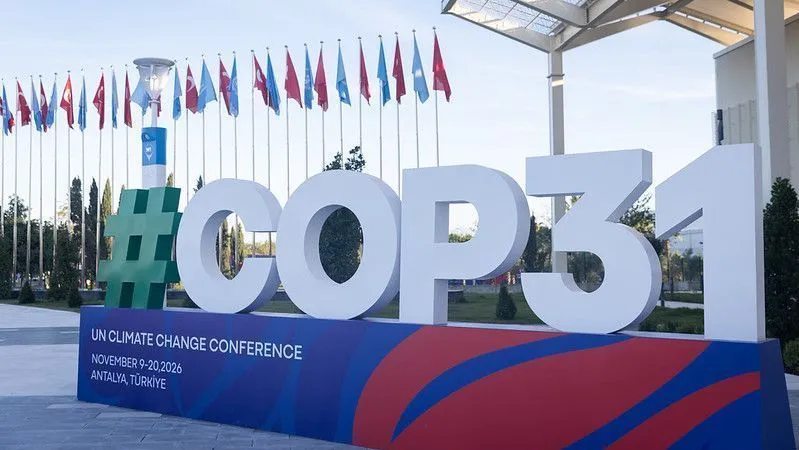
Thirty climate conferences have given sovereign island states a rare platform to negotiate on equal terms with the world’s largest economies, and helped establish many of the international institutions that now support climate action. Yet global emissions continue to rise, climate finance remains insufficient, and several million people living in non-sovereign island territories still lack representation in the process.
For islands, the question is not simply whether the COP process has worked. It is who has been able to participate, what the negotiations have delivered, and why progress remains so limited.
AOSIS and the role of small island states
The Alliance of Small Island States (AOSIS), established in 1990, brings together 39 small island and low-lying coastal states to coordinate their positions in international climate negotiations.
For its members, the COP is one of the few international forums where countries such as Tuvalu, Vanuatu and Antigua and Barbuda can negotiate on formally equal terms with the world's largest economies. Despite their limited economic and political influence, island states have used this platform to shape important parts of the global climate agenda.
Their advocacy has been particularly influential in securing recognition of the 1.5°C temperature limit and advancing the issue of loss and damage. In 1991, Vanuatu, on behalf of AOSIS, proposed an international mechanism to address losses associated with sea-level rise. More than three decades later, the COP process established the Fund for Responding to Loss and Damage.
These achievements demonstrate the diplomatic influence that coordinated island representation can have. However, formal participation does not mean that all island communities have an independent voice in the process.
Non-sovereign island territories: a gap in representation
The UN climate process is open to states and regional economic integration organisations. Territories governed by another country cannot therefore participate in the UNFCCC as independent Parties.
This affects several island territories, including French Polynesia, New Caledonia, Puerto Rico and Montserrat. Their interests may be represented through the delegations of the countries responsible for their international relations or administration, even when their economic circumstances, environmental exposure and development priorities differ.
The consequences extend beyond diplomacy to access to climate finance. A 2024 feasibility study commissioned for the Green Overseas climate finance community examined 25 Overseas Countries and Territories. Of the 148 international climate funds assessed, it identified 68 potentially accessible instruments, only nine of which focused specifically on adaptation.
The distinction between political status and climate vulnerability is also important. Cook Islands and Niue, which are self-governing states in free association with New Zealand, participate in the UNFCCC as Parties in their own right. French Polynesia and New Caledonia do not have the same status.
Sovereignty does not guarantee access to finance either. The Bahamas, for example, is classified as a high-income country, which can restrict access to some concessional and ODA-based funding, despite its significant exposure to climate impacts. The Multidimensional Vulnerability Index, adopted by the UN General Assembly in 2024, seeks to address some of these limitations by recognising structural vulnerability alongside income. Its use in financing decisions remains voluntary.
The result is an uneven system. While sovereign island states have a formal negotiating voice, non-sovereign territories often depend on others to represent their priorities. Both face barriers to securing the resources needed to respond to climate change, but those barriers are different.
Thirty years of climate negotiations
The history of the COP process can be summarised through three periods:
1995-2004: Building the architecture. The first decade established the foundations of international climate cooperation. The 1997 Kyoto Protocol introduced emissions reduction targets for industrialised countries. Its impact was limited by the absence of the United States and the time required to agree on implementation rules. For island states, it was an important first step, but its commitments fell short of the action they were calling for.
2005-2014: From Copenhagen to Paris. The 2009 Copenhagen conference failed to deliver the comprehensive agreement many had expected. It nevertheless helped establish the political ambition of limiting warming to below 2°C and mobilising USD 100 billion annually in climate finance by 2020. Island states continued to advocate for the more ambitious 1.5°C limit. Subsequent COPs established the Green Climate Fund, launched negotiations for a universal climate agreement and created the Warsaw International Mechanism on Loss and Damage.
2015-2025: The Paris era. The Paris Agreement established the goal of keeping warming well below 2°C while pursuing efforts to limit it to 1.5°C. It introduced a system of national climate plans, known as nationally determined contributions (NDCs), which countries are expected to strengthen over time. Later COPs developed its implementation framework, established the Loss and Damage Fund, called for a transition away from fossil fuels in energy systems and agreed a new climate finance goal of at least USD 300 billion annually by 2035.
Two major disagreements have persisted throughout these decades: how responsibility for emissions reductions should be shared between developed and developing countries, and how to address fossil fuels and climate finance. While the Paris Agreement provided a framework for national commitments, there is still no binding global timetable for ending fossil fuel production and use.
What has the COP process delivered?
The negotiations have created a substantial international climate architecture. Its main achievements include:
A global framework for climate action, bringing countries together under common agreements and reporting structures.
A system for measuring progress, through the Paris transparency framework and national climate plans.
International climate finance mechanisms, including the Green Climate Fund, Adaptation Fund and Fund for Responding to Loss and Damage.
Recognition of island priorities, including the 1.5°C goal, adaptation and the need to address loss and damage.
International carbon market rules, developed under the Kyoto Protocol and Article 6 of the Paris Agreement.
These achievements matter. Climate Action Tracker estimated that global warming projections under existing policies fell from approximately 3.6°C in 2015 to around 2.6°C in November 2025. The Paris framework has helped create the conditions for stronger climate action, although this progress cannot be attributed to the COP process alone.
However, the gap between institutional progress and measurable results remains substantial.
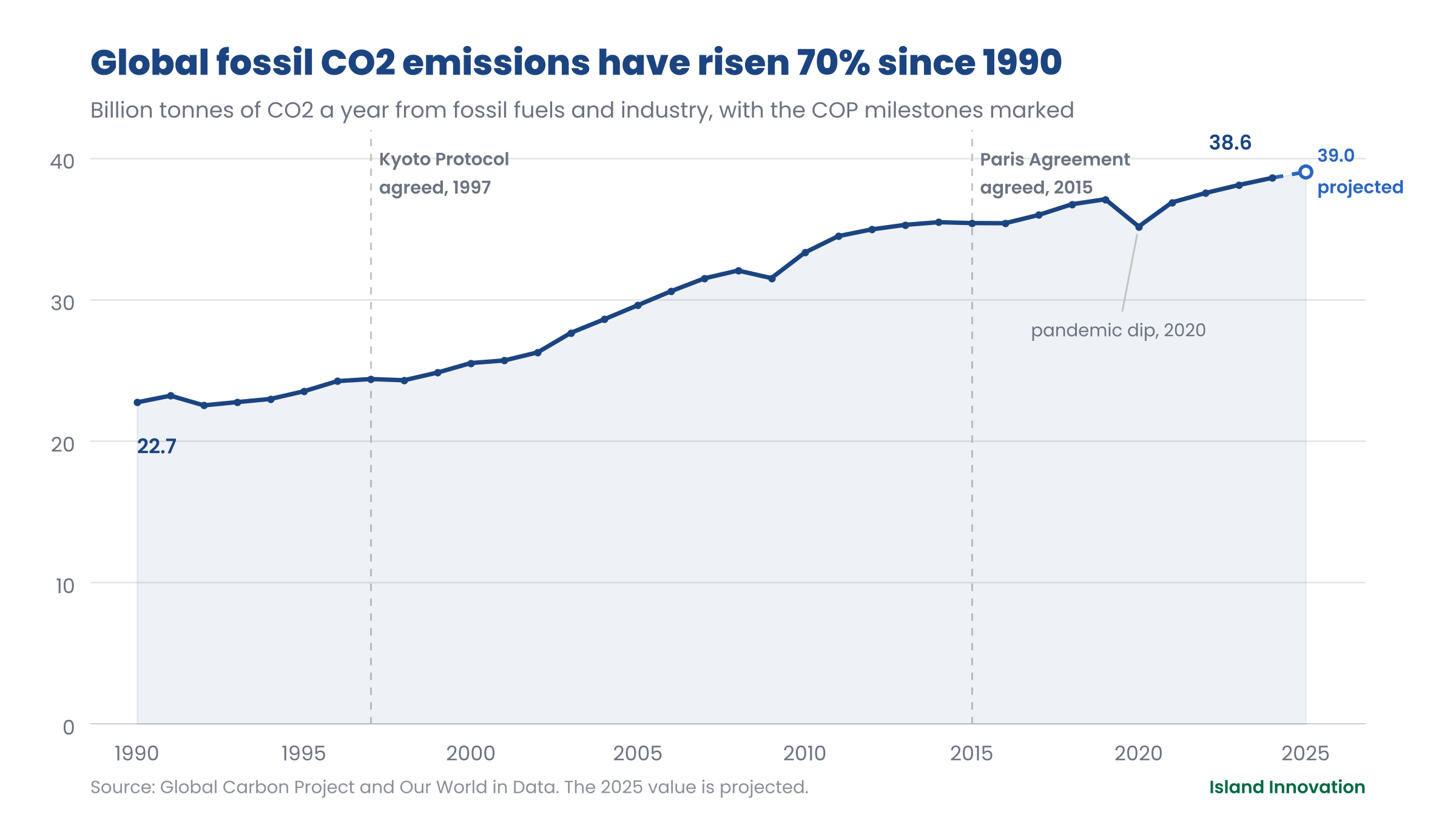
Global fossil fuel CO₂ emissions continued to rise throughout the period covered by the COP process, reaching an estimated 38.1 billion tonnes in 2025. The remaining carbon budget for a 50% chance of limiting warming to 1.5°C was estimated at around 170 billion tonnes at the beginning of 2026.
Climate finance also falls short of what is needed. In 2022, loans represented 69% of public climate finance provided bilaterally and through multilateral channels by developed countries, while grants accounted for 28%, according to the OECD. For island states already facing significant debt pressures, the terms of climate finance are as important as the amounts provided.
Adaptation finance remains far below estimated requirements. UNEP estimates that developing countries will need approximately USD 310 billion annually by 2035 to meet their adaptation needs. Meanwhile, the Loss and Damage Fund, established in 2022 and operationalised in 2023, still has resources that are small compared with the scale of climate-related losses.
Why progress remains limited
The COP process has helped establish international agreements and institutions, but turning these commitments into measurable results remains difficult. A decision made at an international conference must pass through several stages: national commitments, domestic legislation and policies, funding, institutional implementation and, finally, results on the ground.
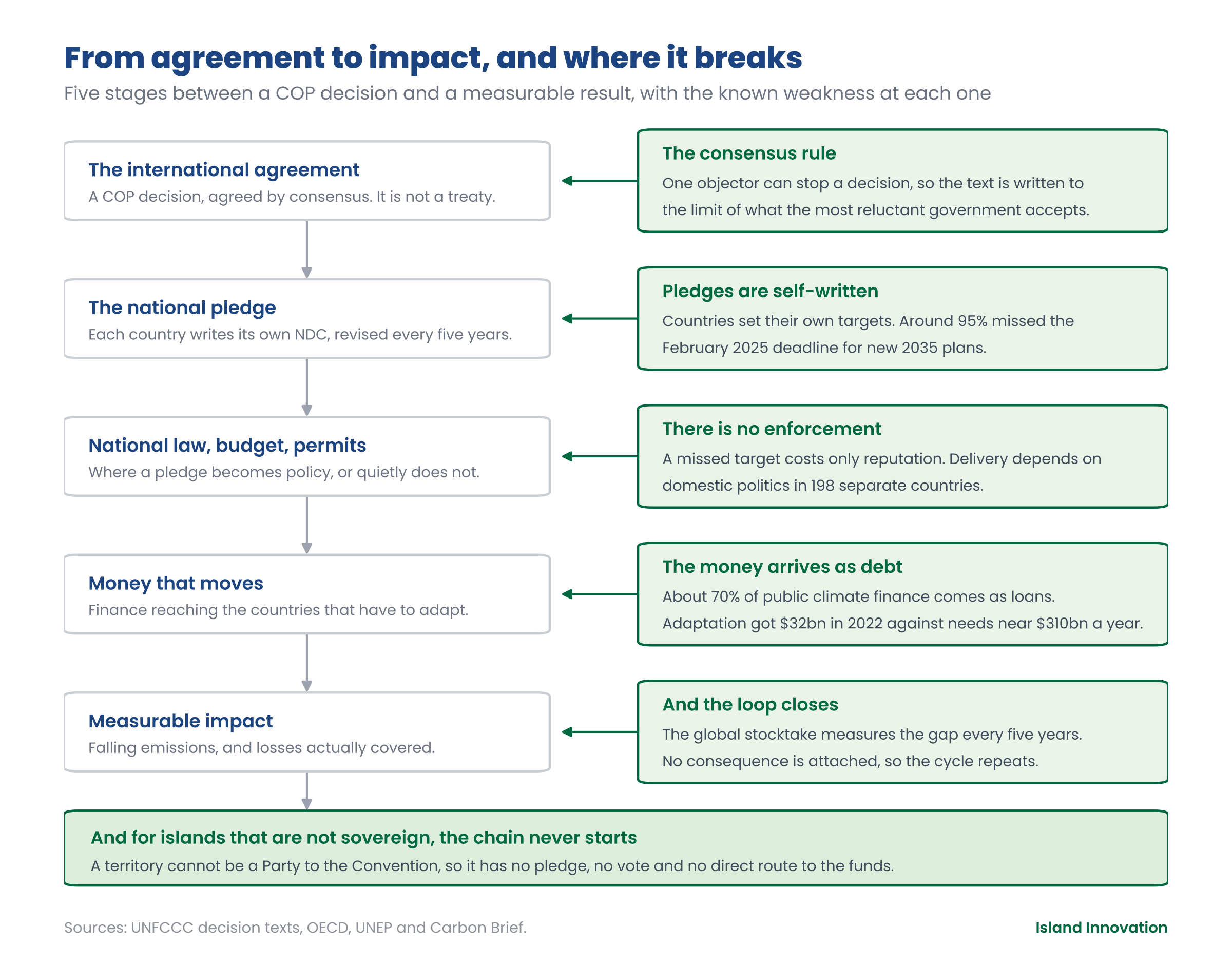
The Paris Agreement requires countries to prepare and update national climate plans and report on their progress. However, it does not impose penalties for failing to achieve the emissions targets set out in those plans. Implementation therefore depends heavily on domestic political decisions, institutional capacity and available resources.
Three further obstacles affect the negotiations themselves.
Influence and representation.
The presence of fossil fuel industry representatives at climate negotiations has raised concerns about the influence of commercial interests on decisions concerning the future of fossil fuels. At COP30, Global Witness identified more than 1,600 participants with fossil fuel industry affiliations among those holding access passes.
This imbalance is also visible in negotiating capacity. Small island delegations often have only a handful of negotiators covering multiple technical areas and parallel sessions. Larger economies can bring much bigger teams, with specialists in finance, carbon markets, energy and legal matters. This affects the ability of island governments to follow negotiations, defend their positions and participate in technical discussions.
For non-sovereign territories, the challenge is greater still. They do not have independent delegations and must rely on their administering countries to represent their priorities.
Political interests and the credibility of the process.
The country hosting a COP influences its agenda, chairs negotiations and helps shape the political process. Recent hosts have included major fossil fuel producers such as the United Arab Emirates and Azerbaijan. While the UAE Consensus in 2023 included the first collective call for a transition away from fossil fuels in energy systems, COP30 did not secure a new roadmap for phasing out fossil fuels.
Political changes also affect the continuity of climate commitments. The United States' withdrawal from the Paris Agreement took effect on 27 January 2026, and the federal government did not send an official delegation to COP30. The absence of one of the world's largest historical emitters weakened the political weight of the negotiations.
In November 2024, former UN climate leaders and other prominent figures, including Ban Ki-moon, Christiana Figueres and Mary Robinson, signed an open letter arguing that the COP process was no longer fit for purpose in its current form. They called for greater emphasis on implementing existing commitments and questioned whether countries opposed to the energy transition should host future conferences.
Cooperation beyond the COP process.
Some governments are increasingly pursuing specific climate initiatives outside the formal UN negotiations. At COP30, the Brazilian presidency advanced proposals for roadmaps on fossil fuels and deforestation, although these did not become negotiated commitments in the final agreement.
In April 2026, Colombia and the Netherlands hosted the first international Conference on Transitioning Away from Fossil Fuels in Santa Marta. The second conference, to be co-hosted by Tuvalu and Ireland in Tuvalu in 2027, will provide another opportunity to develop practical cooperation.
These smaller coalitions can make it easier to agree on specific initiatives and accelerate action. However, they also change the political dynamics. Within the UNFCCC, Tuvalu has the same formal standing as the United States. In voluntary coalitions, its influence depends more heavily on diplomatic relationships, political leadership and the ability to build alliances. For island states, the challenge is to engage in these initiatives without losing the negotiating position they have secured through the UN process.
The COP process should not be judged only by its failures. Climate Action Tracker's estimates of global warming under current policies fell from approximately 3.6°C in 2015 to around 2.6°C in November 2025. This improvement cannot be attributed exclusively to the COPs, as technological developments, national policies and other initiatives have also contributed. Nevertheless, the Paris framework has helped establish the conditions for stronger climate action.
The central question is whether the process can now move faster from international commitments to implementation, at the scale required by the climate crisis.
What it means for islands now
The 1.5°C threshold is becoming increasingly difficult to achieve. The Global Carbon Budget estimates that the remaining carbon budget for a 50% chance of limiting warming to 1.5°C is almost exhausted.
This does not mean that the target has ceased to matter. Every fraction of a degree still affects the scale of climate impacts, and limiting the extent and duration of any temporary overshoot remains essential.
For islands, the difference is substantial. The IPCC has estimated that warm-water coral reefs could decline by 70–90% at 1.5°C of warming, compared with more than 99% at 2°C.
For economies that depend on reef fisheries, marine tourism and the natural coastal protection provided by coral ecosystems, this difference has direct implications for livelihoods, infrastructure, food security and the long-term viability of communities.
Three priorities should shape the island climate agenda over the coming years.
Finance must become accessible and appropriate to island circumstances.
Adaptation finance, loss and damage and the terms on which climate support is provided remain central questions.
The COP30 agreement to triple adaptation finance by 2035 is a political commitment. Its value will depend on how much additional funding is mobilised, how much reaches vulnerable countries and communities, and whether it is provided through grants, concessional finance or other appropriate instruments.
For small island states, the priority is to secure funding that reflects their vulnerability and fiscal constraints. For non-sovereign territories, the challenge is to develop financing arrangements that recognise their specific circumstances and allow them to access resources without unnecessary administrative barriers.
Legal accountability is becoming a new instrument.
On 23 July 2025, the International Court of Justice delivered its advisory opinion on the obligations of states in respect of climate change, following a request initiated by Vanuatu and supported by a broad coalition of countries.
The Court clarified that states have obligations under international climate treaties and customary international law to protect the climate system. It also explained that failures to meet applicable obligations may constitute internationally wrongful acts and can give rise to legal consequences, including reparation where the relevant conditions are met.
The advisory opinion is not itself a binding judgement against individual states. However, it provides an important legal reference for governments, courts and communities seeking accountability for climate-related harm.
The initiative led by Vanuatu demonstrates how a small island state can use international law to advance an issue that has struggled to gain sufficient attention through political negotiations alone.
Representation must extend beyond sovereign states.
The international climate system still lacks an adequate approach to the representation of non-sovereign island territories.
Many face the same climate pressures as sovereign island states: rising sea levels, coastal erosion, water insecurity, extreme weather and dependence on vulnerable infrastructure.
Their exclusion from independent participation in the UNFCCC creates a gap between the people affected by climate decisions and the institutions responsible for making them.
Greater recognition of subnational island jurisdictions, more direct participation in technical discussions and improved access to climate finance should become part of the international agenda.
Cooperation between sovereign island states and non-sovereign territories can also strengthen the collective representation of island priorities.
What to watch
Several developments over the next twelve months will indicate whether climate diplomacy is translating into stronger action for islands.
COP31 in Antalya, November 2026. With Australia leading the negotiations and Türkiye hosting, the key question is whether the conference will deliver stronger outcomes on adaptation, climate finance and implementation, building on priorities raised during the Pacific Pre-COP.
Brazil's COP30 roadmaps. Presented on 3 November 2026, the roadmaps address the transition away from fossil fuels and the reduction of deforestation by 2030. Their impact will depend on whether governments turn these voluntary frameworks into concrete policies, investment and measurable progress.
The second Conference on Transitioning Away from Fossil Fuels. Tuvalu and Ireland will co-host the 2027 conference in Tuvalu. It will give a Pacific island state an opportunity to lead international cooperation on the energy transition and bring island perspectives into discussions on reducing fossil fuel dependence.
The only seat at the table
Thirty COPs have established an international climate framework, created financial mechanisms and given small island states a platform to influence global policy. Yet emissions continue to rise, climate finance remains insufficient, and implementation falls short of what island communities need.
For sovereign island states, the UNFCCC remains an essential diplomatic forum, providing a rare opportunity to negotiate on formally equal terms with the world's largest economies. For non-sovereign territories, the challenge is to secure meaningful representation and better access to climate finance.
The next phase of climate diplomacy must turn international commitments into practical results, while ensuring that all island communities have a voice in the decisions that affect their future. For islands, having a seat at the table matters. What matters now is what that seat can help deliver.
Sources and further reading
COP outcomes and the UN climate process
Emissions, warming and national commitments
Climate finance, adaptation and loss and damage
The process and its critics
UN climate summits no longer fit for purpose, leading experts say, The Irish News
Fossil fuel lobbyists flood COP30 with largest ever attendance share, Global Witness
First Conference on Transitioning Away from Fossil Fuels, Santa Marta, Colombia
Second Conference on Transitioning Away from Fossil Fuels, Tuvalu and Ireland
Islands, territories and representation