
Decentralised Desalination Strengthens Saba’s New Climate-Resilient Harbour
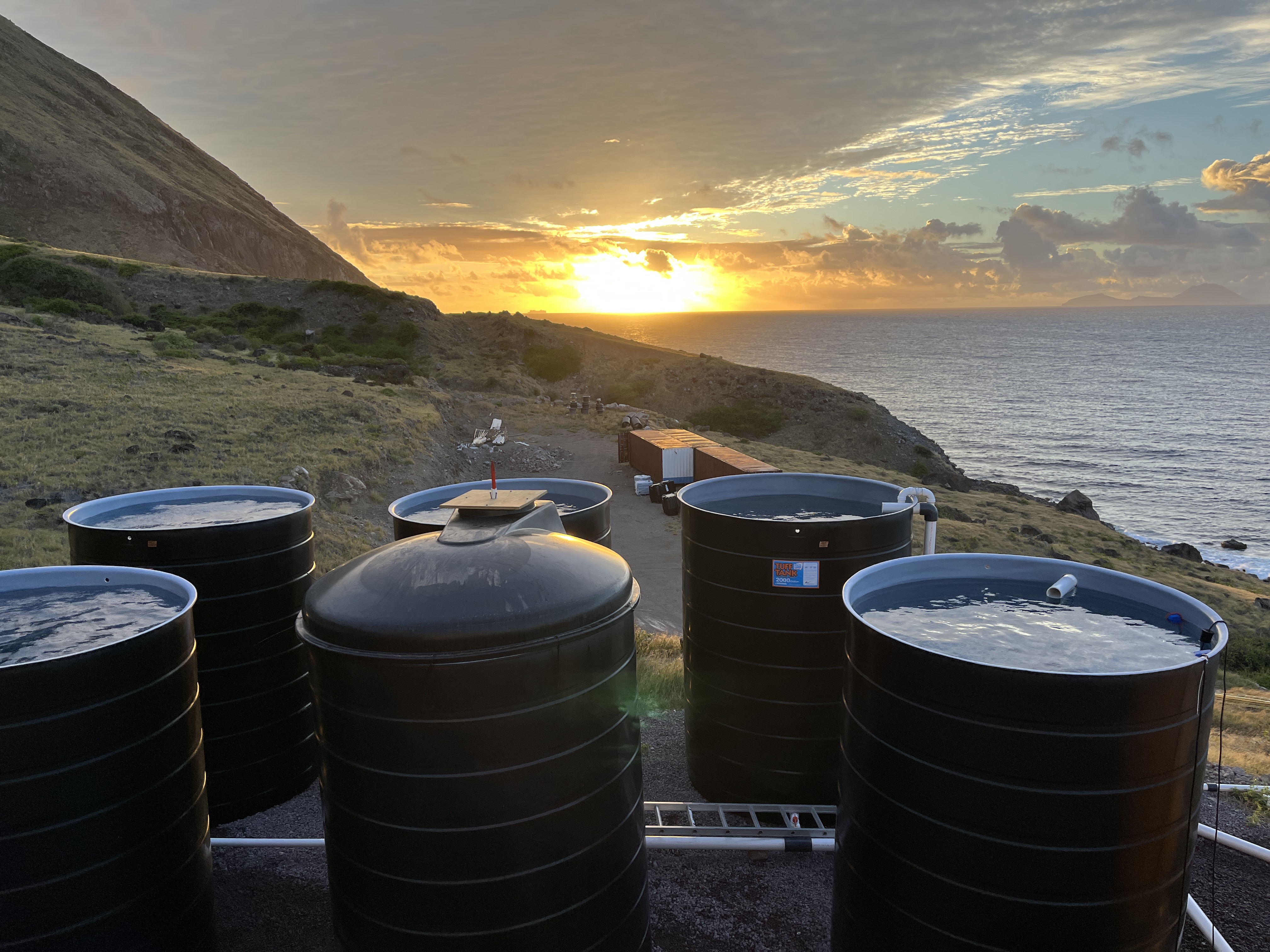
On the small Caribbean island of Saba, Dutch water and maritime expertise is helping tackle several challenges at once: limited freshwater availability, exposure to hurricanes, difficult logistics, and the need to protect a vulnerable marine environment.
At the centre is the new Black Rocks Harbour, which is being constructed by Dutch company Ballast Nedam International Projects on behalf of the Public Entity Saba. As part of the project, Elemental Water Makers, a Dutch water technology company, has delivered a decentralised desalination system that gives the construction site its own reliable freshwater supply. The combination shows how Dutch expertise in water technology and hydraulic engineering can support resilient infrastructure in remote and water-scarce locations – and offers solutions that can be replicated elsewhere.
Creating water where it is needed
Building major infrastructure on a small volcanic island raises an immediate question: where does the water come from?
At peak construction, around 125 people are expected to work on the Black Rocks Harbour project. Freshwater is needed not only for their daily needs, but also for concrete production, dust suppression and other construction activities. Bringing in large volumes of water or drawing extensively on Saba's existing resources would add logistical pressure and potentially compete with local demand.
Elemental Water Makers has addressed this challenge with a containerised reverse-osmosis desalination system. The installation produces freshwater from seawater on site and has been commissioned on Saba. The project team has been trained to operate and maintain it, and remote support is also provided from the Netherlands. The system incorporates energy-recovery technology that reuses pressure from the desalination process. According to Elemental Water Makers, this can reduce energy consumption by around 70 percent compared with conventional reverse osmosis systems. The installation is also designed to operate without chemical treatment during the desalination process.
A harbour designed for a changing climate
Water supply is only one element of a much wider resilience challenge. Saba depends heavily on maritime connections for goods, transport and economic activity. Following the damage caused by hurricanes Irma and Maria in 2017, plans for the harbour grew from renovation to the construction of an entirely new, hurricane-resistant facility. Ballast Nedam International Projects is responsible for the marine works. These include dredging, harbour infrastructure and the construction of a large breakwater using heavy Xbloc concrete blocks designed to withstand severe sea conditions and hurricane-force waves. The main maritime components are scheduled for completion in December 2026. The design has undergone extensive wave modelling and testing. Public Entity Saba says that the resulting breakwater will be almost twice the size of that of the existing harbour, helping raise the level of protection required under extreme conditions.
Combining Dutch knowledge with local capacity
The project is also an example of how international expertise can be combined with local and regional knowledge. Rather than permanently operating the desalination installation with specialists brought in from abroad, Elemental Water Makers trained the project team on Saba on operation and maintenance. Its modular and containerised design also means that the technology can be deployed without constructing a conventional large-scale desalination plant. Similarly, the wider harbour project combines Dutch engineering with Caribbean participation. Specialised concrete Xblocs are being produced on nearby Sint Eustatius, while Saban contractors and suppliers are involved in transport, materials and construction activities. Materials from the demolition of a former school gym are even being reused as backfill for the access road. Environmental protection has required its own set of solutions. In cooperation with the Saba Conservation Foundation and coral restoration specialists, more than 1,000 corals have been relocated from the construction area. Water quality is monitored during construction and working methods have been adapted when elevated turbidity poses a risk to the surrounding reef.