Seychelles Protects 48% of Land, 32% of Seas, Hailed as Island Conservation Model in Global Report
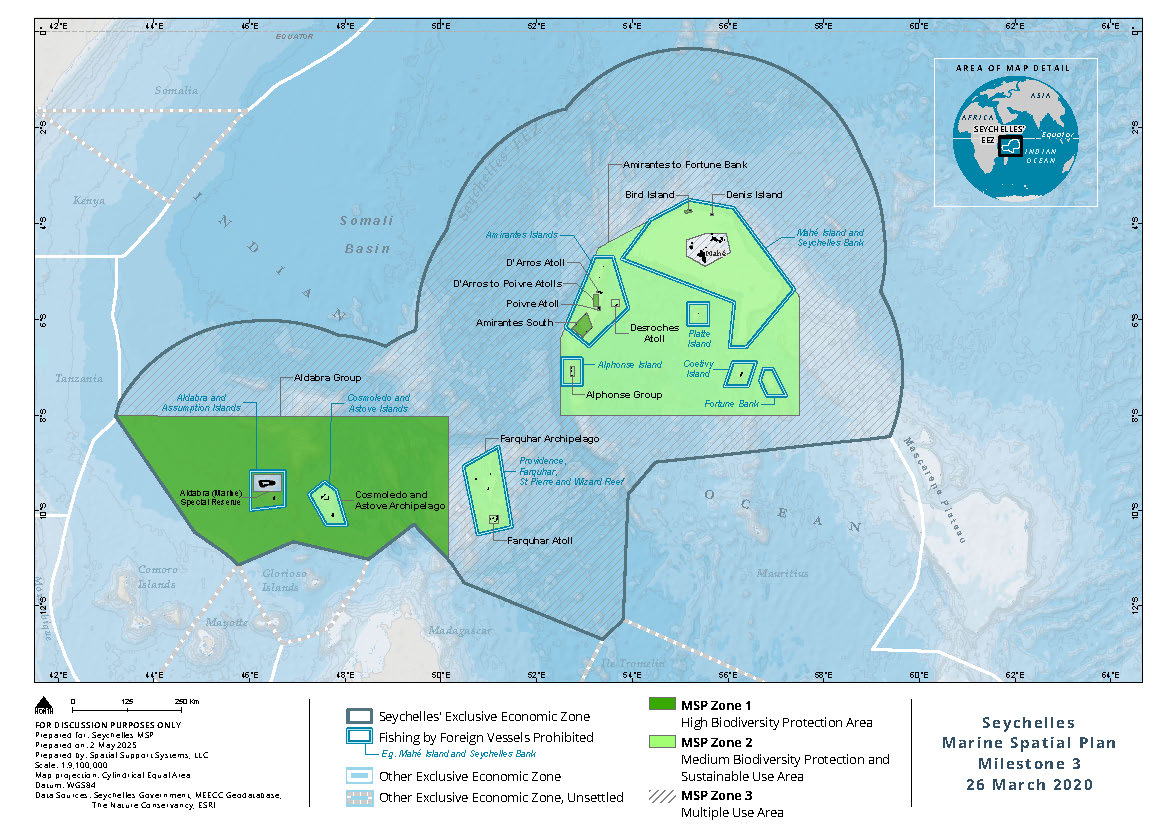
Seychelles has been highlighted as a model for other small island developing states in a global biodiversity report, with 48.1% of its terrestrial areas and 32.6% of its marine areas under protection and conservation.
The 2026 State of Biodiversity Action report, published by the Secretariat of the Convention on Biological Diversity, says Seychelles has exceeded the international target to conserve at least 30% of land and sea areas by 2030.
Drawing on Seychelles' seventh national report to the Convention, the publication features the country as an example of how legal reforms and coordinated management of land and sea can support biodiversity conservation.
“Seychelles has demonstrated how a small island developing State can strengthen biodiversity conservation through integrated governance, legal reform and ecosystem-based spatial planning,” the report states.
It highlights the country's “ridge-to-reef” approach, which connects the management of terrestrial, coastal and marine ecosystems under a common policy framework.
The report credits the Nature Reserves and Conservancy Act of 2022 and Seychelles' marine spatial plan of 2025 with modernising conservation legislation and incorporating ecosystem-based management into national planning.
National ministries and agencies have coordinated legal reforms, conservation assessments, the expansion of protected areas and evaluations of management effectiveness. The marine spatial planning process also involved scientific analysis and extensive stakeholder engagement, according to the publication.
The measures cover forests, coastal habitats, coral reefs, seagrass ecosystems and offshore marine environments. Actions include identifying ecologically important areas, establishing ecological corridors and designating seasonal protection zones for threatened species.
“These measures have exceeded the global ‘30×30’ conservation targets, achieving protection and conservation coverage of 48.1% of terrestrial areas and 32.6% of marine areas under the jurisdiction of Seychelles,” the report says.
Beyond the area covered, the publication credits the approach with strengthening connections between ecosystems, improving species protection and supporting resilience to climate change.
It says Seychelles has “established a governance model for other small island developing States seeking to integrate terrestrial and marine conservation within a single national framework.”
However, the report also recognises the pressures facing the country, including its dependence on marine fisheries and tourism, limited financial and technical resources, and increasing exposure to coral bleaching, sea-level rise and extreme weather.
“The integrated framework provides a mechanism for balancing conservation and development objectives while improving ecological resilience across interconnected ecosystems,” it states.
The Seychelles case study appears in the report's assessment of Target 3 of the Kunming-Montreal Global Biodiversity Framework, which concerns the conservation of at least 30% of terrestrial and inland water areas, and marine and coastal areas, by 2030.