
Statia Students Investigate Water Quality in Hands-On Environmental Science Activity
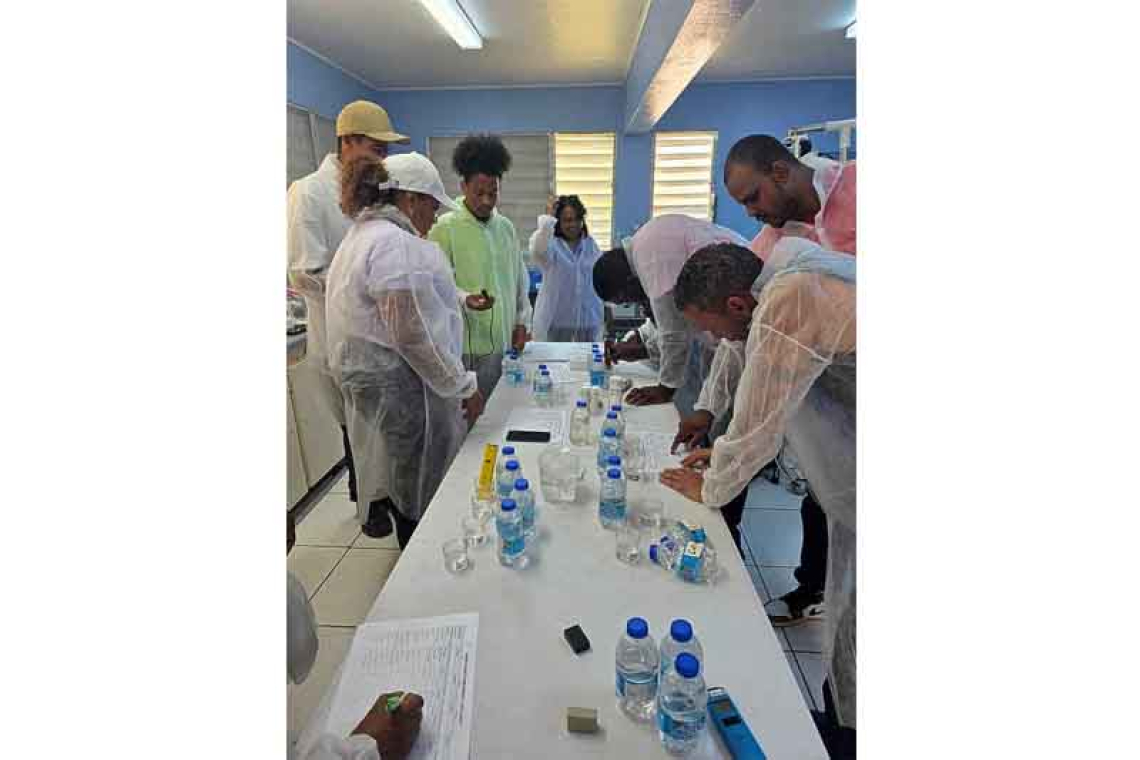
Students from the New Challenges Foundation (NCF) Empowerment Programme took part in a hands-on environmental science activity on Friday, October 23, investigating water sources on St. Eustatius as part of an initiative linking classroom learning with environmental monitoring and agricultural sustainability.
The activity, entitled “Every Drop Has a Story”, brought together visiting representatives of the World Wildlife Fund (WWF) from the Netherlands and Curaçao, representatives of the Unit of Agriculture, Livestock and Fisheries (LVV), and other participants. It was led by Sara Stone, Island Coordinator of the Agrivoltaics Project at the STUCO Solar Park, with the participation of LVV Extension Officer Jake Sams.
Participants collected and examined samples from four sources: an open pond at the STUCO Solar Park, a rainwater catchment cistern at the park, a groundwater well on the Made in Statia property, and water processed through the XPLORIT reverse-osmosis treatment system.
Using scientific equipment and multi-parameter water-quality test strips, they examined characteristics including pH, electrical conductivity, salinity, turbidity and other chemical indicators.
The exercise was intended to establish baseline data for comparison with future measurements, rather than determine which source was best or draw immediate conclusions about water quality. Some results require further interpretation and verification, with a subsequent report expected to present the findings and their implications for agricultural water management.
Stone said the activity also demonstrated how environmental investigations can reinforce learning across several subjects. Students practised following procedures, recording measurements, interpreting numerical scales and describing observations, while developing scientific knowledge and English vocabulary.
A water sample, she explained, can provide a practical lesson in mathematics when measurements are compared, in English when observations are described, and in science when chemical properties are investigated. It can also introduce environmental questions concerning rainfall, drought, groundwater and sustainable agriculture.
The activity reflects the approach of the international GLOBE (Global Learning and Observations to Benefit the Environment) Programme, which involves students in structured environmental observations and scientific investigations, including monitoring water, soil and weather.
Stone said students in St. Eustatius should have greater opportunities to participate in practical environmental science, pointing to the island’s agricultural challenges, biodiversity, coastal ecosystems and renewable-energy developments as resources for meaningful investigations.
She also expressed disappointment that some schools which had previously indicated an interest in the activity were unable to accommodate it in their schedules. She called for hands-on learning to be recognised as an integral part of academic development rather than treated as an occasional extracurricular activity.
Beyond the educational benefits, the investigation has implications for local food production. St. Eustatius faces challenges in securing reliable water resources for agriculture, particularly during droughts and after extreme weather events.
The samples were assessed for potential agricultural uses, including irrigation, and not for drinking-water suitability. Understanding the characteristics and reliability of available water sources is expected to become increasingly important as agricultural initiatives at Made in Statia and the STUCO Agrivoltaics Project develop.
Stone said food security involves more than increasing vegetable production. It also depends on water availability and quality, soil conditions, energy systems and environmental resilience. Maintaining local agricultural production can be particularly important when hurricanes disrupt transportation and imported food supplies.
The October 23 investigation is intended to be the starting point for a longer-term environmental record, with quarterly monitoring and comparative analysis planned. Future activities could include observations of air temperature, humidity and cloud cover, using methods consistent with GLOBE learning protocols.
Stone said the aim was to help students develop curiosity, confidence and the ability to ask questions about the environment around them.